The Names
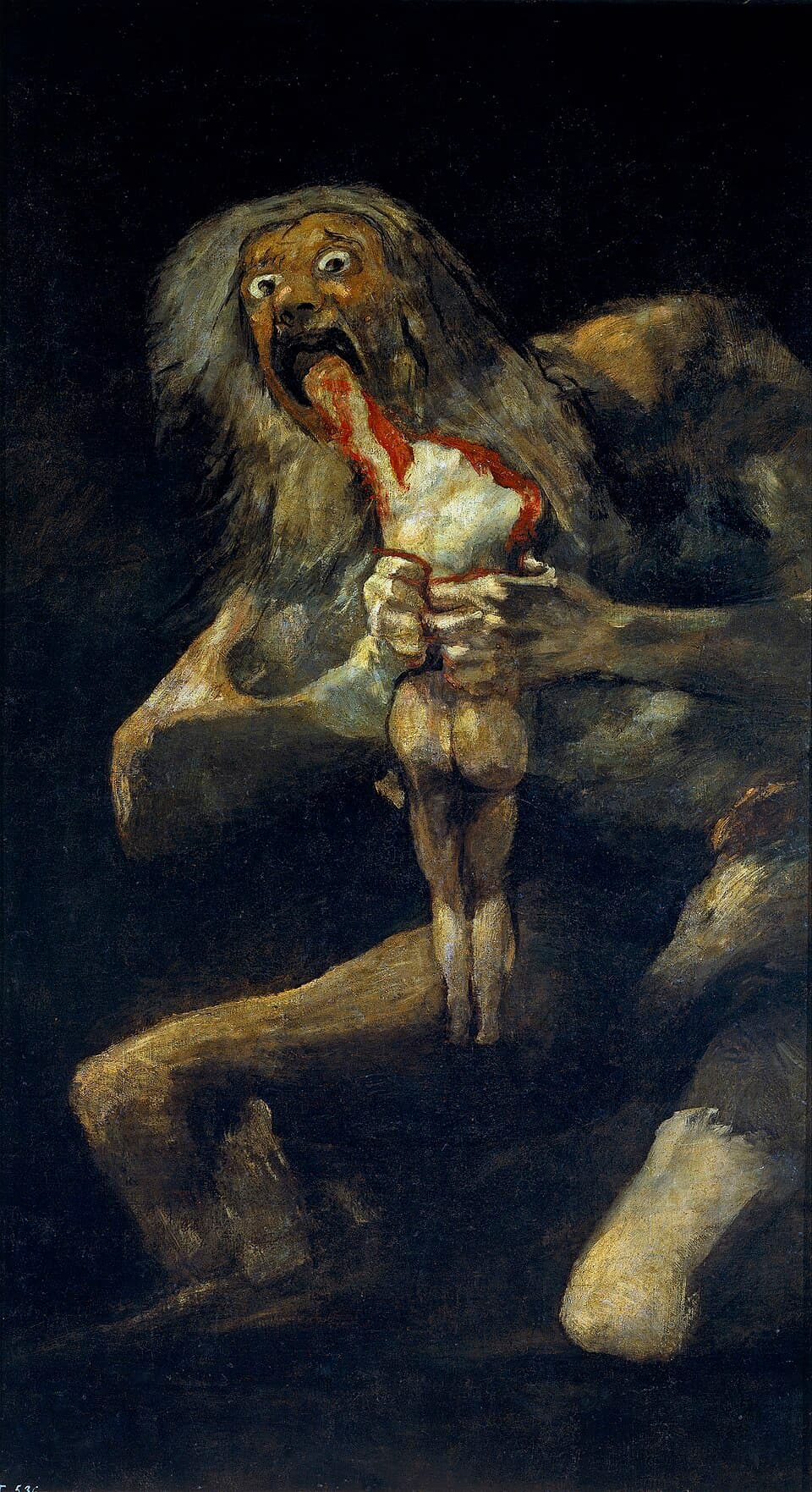
Saturn eating his son, or Cronus eating his son, is used as a metaphor for the cycle of abuse in The Names. The God Saturn's face is not happy, or malevolent. It appears, almost, scared. Or maybe monstrously indifferent; Its face perhaps not in any way deliberate to the point of unselfconsciousness. I think for the purposes of this book, however, scared is the correct interpretation.
The cycle of abuse is easy enough to understand. Tension, incident, reconciliation, calm. The power and control wheel also, easy enough to understand. Intimidation, emotional abuse, isolation, gaslighting, children, decision domination, economic abuse, and threats. In this book all aspects of abuse are seen and made use of. All characters react to and are shaped by the abuse. And it manages to make the abuse truly tensious. I myself had to put the book down many times, so difficult was it to endure the event itself or the tension in the buildup.
Some part of her realizes he's only just beginning; that there are only so many times she will feel the flux of brain, skull and flesh against metal before she does not. And so she overrides her wish not to disturb Bear, and does something shes's never done before: she screams for help. Not just once, but over and over, knowing the small window in the pantry is open, that the door is ajar, that it will be impossible for someone in the cul-de-sac not to hear. When he covers her mouth, she clamps her teeth down hard on the side of his hand, sinking into flesh and wiry hairs. He recoils, surprised. But it's only a moment's relief, because now there are a few feet between them and she realizes that he will use this as a run-up, that he's about to charge. She springs sideways and feels the midwife's careful stitches pop. But there is no pain, just a rush of adrenaline, as he chases her through to the living room. He grasps her hair again, but she jerks away and is freed, a prickle of white heat at her scalp.
Holy fucking shit. Just jeeeesus christ. I read "See What You Made Me Do" by Jess Hill, and not a single description of non-fictive violence stands out to me as viscerally as that one. And that to me is the value of fiction. Non-fiction cannot create this without, somewhat, being accused of sensationalism. Editorialising. It cannot capture the chaos and the pathos and the heroism as easily and comfortably. And indeed, Jess Hill did in fact describe husbands who could not wait to have sex with their wives until the stitches healed. And yet I feel more strongly reacting to this than I did back then.
What is impossible for the reader to know, is that this is in fact the 'best' timeline. The family, suffering an acute stressor, in many ways have their lot greatly improved by this act of heroism and defiance. And what I have just hinted at, is that yes, the other timelines where she didn't do this are also explored. And that is where this book really starts to shine. It presents very clearly seemingly negative events that, in the moment, we cannot know the consequences of. And in fact the other timelines have tension, and they have abuse, for instance, in one of them where she named him Julian, there is further physical abuse, but not as severe. And no abuse when she named him Gordon. And yet although the short-term effects of those less tensious actions are less severe, the long-term consequences are worse in every way for every one.
In the different timelines outside of the Bear timeline, the characters are all emotionally more stunted, more awkward, less social, more emotionally backed up. Although they find their ways through life, and survive in a literal sense, there is this feeling in the other two timelines of delayed development. That the characters take longer to 'find themselves'. But the book does something very beautiful eventually. It chooses to ensure that all of the timelines contain their tragedies. With the death of Bear from a wasp sting in the Bear timeline, it shows how the entire human community who surrounded him were stronger, more resilient, and more emotionally capable of dealing healthily the loss of him. The world that he left behind was capable of sustaining his absence without true decline. This is in direct contrast to the Gordon timeline, for whom his descent into alcoholism, culminating in a high speed crash that left him hospitalised for months, is actually an OPPORTUNITY for him to take stock of himself and his life. To understand how he has alienated his family and friends, and that in fact his life has little of permanence or dependability.
This contrast of the nature of tragedy and the nature of life's big events between timelines demonstrates, in a way that non-fiction never could, the possibilities of our lives, and the primary binding force between all of them is when the characters directly address their problems. And although it's stated so simplistically in that sentence that it feels reduced, the fact is that simple things are often hard. That often, improving, or doing the right thing, is the hardest thing to do. Often the simplest remedy to an emotional, personal problem is the one that people oh so hate to hear. And in this book there is only one timeline where the characters were given the luxury of making those simple, good decisions whilst young. That is one of the effects of abuse. I wouldn't like to posit the ranking of various maladies that abuse inflicts. It would seem to elevate it above other aspects. But the lost time of it all, the waste. They could be happy, in simple terms, but instead now they must endure years and years of slow, calcifying experiences that they must unlearn.
I didn't really like the ending. The epilogue is from Gordon's perspective, I don't know which timeline. But he suffers a heart attack and collapses on the floor, and he dies. And as he dies, he imagines different timelines for himself, ones in which he didn't abuse his wife, or meet Cora at all. And frankly. I didn't like it. The story was not about him, he is merely a vehicle for abuse. In many ways a demonic, ethereal force. Especially since the kids don't typically refer to him as dad or as Gordon, but instead just as 'him'. And as such to suddenly potentially place him in any light at all just feels wrong.
The Names explores, over three timelines, the effects of domestic abuse. The three timelines are delineated by the fact that in each, the youngest child has a different name. Bear in the best, Julian in the second best, and Gordon, after his father, in the worst.
The reason that Bear is the best is because a man intervenes in the bashing of Cora, his mum. Gordon, deliberately or not, kills him. Julian is the second best because Gordon kills Cora when he's about 8, and thus they are sent to live with their grandparents. And Gordon the worst because nothing as enormously and obviously tragic as that happens, they just live with their parents, the abuse ongoing even into their adulthood.
What is very interesting in these three stories is that the author chooses to explore further tragedy even within the timelines. The spousal abuse is not the only bad thing to happen. Bear dies to a wasp sting, suffering anaphylaxis. And his daughter and wife have to live on without the wonderful man he grew up to be. Julian suffers the near divorce of his wife, as his fear of England causes him to lose money. Gordon, in a different way, becomes an alcoholic and then crashes a car. And in these tragedies is the author able to explore the further effects of the abuse and familial home on the children and broader family. For Gordon, his car crash was an opportunity. A wake up call. A moment of rediscovering himself. For Bear, his death was simply a tragedy. But an opportunity, story-wise, to examine the powerful foundation of love he and his family had. For Julian, his fear of England is simply confusing and turmoiled. In all three stories, an extraordinary circumstance takes place. And in all of them, we get to see the reality of the role that abuse plays in their lives.
I didn't like how it ended. Finally, in a way, from the dad Gordon's perspective. After the entire book nearly has barely had him in it, to finally be him was a disappointment. Every timeline in the end had spurned him. And that was how it should have stayed.
The tripartite structure follows Bear, then Julian, then Gordon on a per chapter basis. Thus there is a clear theme of the exploration of nominative determinism. In a broader sense, it explores nature vs nurture.
The epigenetics are fearful for Julian. Who worries that he has the genetics of a murderer. Who worries that he too will become abusive if he is to get angry. For Bear, his family have not even let him know that his name is why Vihaan died. Though he comes to suspect. For Gordon, as his name is his Dad's, he is given scenes with his dad's dad, and therefore comes to understand Gordon the dad best. As a victim himself.
The book reminds me of something I once had to realise. That is, sometimes not enjoying a part of a book is the point. And maybe not for the reasons you expect. In the Gordon naming section especially, you have to watch as Cora fails to escape from Gordon. Coming back, falling into heady love bombing. Literally in the classic abusive loop. You also have to read her inner monologue. Which is rich with, to my mind, slightly soppy descriptions of plants and environment. But slowly, I came to realise that this constant sad description was actually her dissociating from having to think about her abuse. As well, I would say that the book manages to make the abusive violence feel fucking horrible. Small details like her postpartum stitches popping lend an enormous viscerality that punctuates the mood ever since. The tension whenever we are Cora in the Gordon timeline remains strung forever since. In the Julian timeline however the author does not deign to give full bloody detail to the death of Cora, a fact I find respectful and impactful. It is a private thing for those characters to know. And also it would not carry nearly as much impact on the reader having it described rather than experienced. It does once again reify for me my maxim that fiction is greater than non-fiction. In this case it is so because third hand accounts of violence and abuse are not told as a story but as a recount. And a recount has an impersonal aspect, a fact based logic to it. They generally lack the pathos necessary to truly shock me. Every violent act in this book is horrible. The tension before and after constant, and the frustration with Cora falling deeper into the cycle each time worse and worse. In a way the book does a good job alienating yourself from her. She is given little personality except through the non Gordon timelines. She is a shadow of what she could be. And you struggle with that the same way you might in real life.
Maia is gay in all three timelines, but the effects of her dad change dramatically how she perceives herself and her relationships. In the Bear timeline, she is openly gay and happy. In the Julian one she does homeopathy and is sad and lost and closeted. In the Gordon one she is a doctor and closeted.
Bear's jobs change as well in the timelines. In the Bear timeline he is an archaeologist who spends time in the field in Egypt. In the Julian timeline he meets Cian and spends lots of time making jewelry. In the Gordon timeline he is a programmer in finance making lots of money. In each of these timelines he is typified by craftsmanship.
Then there is Lily, his love interest. In the Julian timeline he doesn't even get to meet her. He does make her her wedding ring though. In the Bear timeline he marries her. In the Gordon timeline he sexually assaults her, and then details that derisively to his new 'friends' so that he fits in, and they bully her until she is literally committed to an insane asylum.
He also becomes an alcoholic. Requiring a sponsor. And ends up becoming a programmer for a museum.
The relationships also change. The children become highly avoidant of their father's abuse in the Gordon timeline. Maia feels extremely guilty about it. As she'd likely do more for a random woman than she has for her own mother. This trickles into avoidance generally. She is emotionally more withdrawn, as is Gordon. This avoidance affects their romantic relationships.
The aspect of her talking as an earth mother, that kind of, to me, witchy coven thing, is very much a thing that I found myself rooting for in this book. Yeah, do whatever you need to do to feel strength so you can leave or resist. But homeopathy? laaaame girl. When building a life, remember, you are not relegated to the toys and dolls aspect of living. You can get a computer science degree.
Felix is the vet she loves in Bear's timeline, the vet who tries to help her escape in Gordon's.
The book certainly seems like an allegory for making your gut level decisions and making them hard. Just do what your gut tells you and do it properly.